
Table of Contents
A new system is being introduced for courses commencing on or after 1st January 2027 called a Lifelong Learning Entitlement (LLE), which can be applied for from the end of October 2026.
This guide is designed for medical students, doctors and their families to understand how funding during medical school and subsequent repayment is structured. The guide includes helpful information for different groups such as parents of future medical students, pre-med and current medical students, graduate-entry medical students and current doctors.
What is a student loan?
There are several kinds of student loans and bursaries available to students who have indefinite leave to remain/settled status in the UK (i.e. you have recourse to public funds). If you are considered a “home student” then you are entitled to student loans from the Student Loans Company. You must also have been living in the UK for the previous three years before starting your studies.
This module will focus on the student loans that medical students are most likely to access; undergraduate loans, graduate-entry medicine loans, and the plans very new doctors are likely to be repaying currently. We will also cover what happens when medical students move onto the NHS Bursary. The course must be at a recognised publicly-funded university or college (or a private institution studying a course approved for public funding). Undergraduates can only access a 4-year undergraduate loan once. If they go on to do another undergraduate degree, this needs to be self-funded. There is a separate graduate-entry medicine loan available for students undertaking 4-year graduate-entry medicine degrees.
Tuition Fees Per Year
Students studying full-time in England: £9,790pa
- Accelerated degrees: £11,750 per yearL
- Graduates taking a graduate-entry accelerated degree can get a partial tuition fee loan and a maintenance loan. In 2026/27 the tuition fee loan is £6,125 in Year 1 and £5,860 for Year 2 onwards. In Year 1 you’ll need to pay the remaining fees yourself; from Year 2 the NHS will pay the rest.
Students studying in Wales: £9,790pa
Students not resident in Scotland and studying in Scotland: £9,790pa
- The ScotGEM graduate-entry degree is run in partnership by St Andrews University and the University of Dundee. UK-resident medical students taking this degree can apply for a ‘return of service’ bursary. This offers £4,000 in each year of study. In return, you must commit to work for NHS Scotland for as many years as you receive a bursary. The return of service bursary is open to all students on the programme.
Students resident in Scotland and studying in Scotland: £0
Students from Northern Ireland studying in Northern Ireland: £4,855
Maintenance Loan
The maintenance loan component is means-tested and depends on your household income. Household income defined:
- If you live with one or both of your parents, have not been “independent” and are under 25 years old, your household income would be your parental income.
- For your parental income not to be considered for maintenance loan purposes, and to be considered an “independent student” you need to meet on of the following criteria:
- If you’re married, in a civil partnership, or over 25 and living with your partner, Student Finance England will ask your partner for their National Insurance number and personal income details.
- Evidence: your marriage or civil partnership certificate
- If you’re married, in a civil partnership, or over 25 and living with your partner, Student Finance England will ask your partner for their National Insurance number and personal income details.
- you care for a person under the age of 18 on the first day of the academic year you’re applying for student finance
- Evidence: your child(ren)’s birth certificates, adoption certificates or letter from social services if caring for minor siblings or relatives
- you’re 25 or over on the first day of the academic year you’re applying for student finance
- Evidence: birth certificate or passport
- you’ve been married or in a civil partnership before the start of the academic year (even if you’re now divorced or separated
- Evidence: your marriage or civil partnership certificate
- you have no living parents
- Evidence: their death certificates
- you’ve supported yourself for at least three years before the first day of the first academic year of your course
- Evidence: copies of your P60s, or a letter from your employer(s)
- your parents can’t be traced, or it’s not practical or possible to contact them (see estrangement below)
- your parents live outside the EU and an income assessment would put them in jeopardy, or it’s not reasonably practical for them to send funds to the UK to help support you
- you’ve not communicated with your parents for one year before the start of the academic year that you’re applying for student finance, or you can demonstrate you’re permanently estranged from your parents
- Evidence: a letter from your social worker, a doctor, teacher or person of good standing in the community (solicitor, religious leader or counsellor) who knows your situation or police reports showing any related incidents
- you’ve been in care for any three month period ending on or after the date you turned 16, and before the first day of the first academic year of your course
- Evidence: a letter from your local council or care authority
How household income affects maintenance loan award:
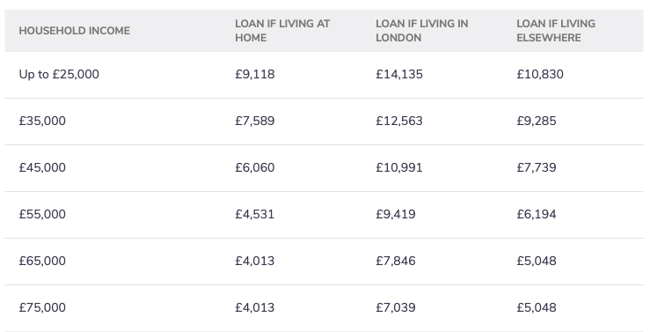
Parental or partner income is taken into account for means-testing from £25,000. If household income is below £25,000, the student is entitled to full maintenance loan. The amount of the maintenance loan award gradually decreases until household income is £70,000 or more- where the student is awarded the minimum amount of maintenance loan (half of maximum award).
The minimum Maintenance Loan on offer for students from England is £4,013. This is paid to students with a household income of £58,387 or more who will live at home during their time at uni. The maximum Maintenance Loan is £14,135. This is paid to students who will be living away from home and in London, and whose annual household income is £25,000 or less.
How term-time location affects loan award
Scotland-resident Students in Scotland
Scotland offers income-dependent bursaries up to £2,000.
Relevant types:
- Young Students’ Bursary (YSB): For students under 25 who are dependent on parents
- Independent Students’ Bursary (ISB): Non-repayable grant for independent students from lower-income households (different rates)
Welsh Government Learning Grant (non-repayable)
Wales offers the Welsh Government Learning Grant (WGLG) for Welsh Further Education students. This is a non-repayable maintenance grant based on household income:
- Universal minimum: Every Welsh Further Education student receives at least £1,020
- Maximum grant: Up to £10,325 for students from lower-income households
- The more grant you receive, the smaller your loan allowance
Northern Ireland-Specific Support
Northern Ireland offers two types of grant. You’ll receive one or the other, not both:
- Maintenance grant (up to £3,569)
- Non-repayable grant based on household income
- The amount of maintenance grant you receive reduces your maintenance loan entitlement
- Your total support package remains the same, but more of it is grant (non-repayable) rather than loan
- Special support grant (up to £3,569)
- Alternative to the maintenance grant for students receiving certain income-related benefits. For more information, see the SFNI website.
- This doesn’t reduce your maintenance loan entitlement
- Not counted as income for benefits purposes
- Provides the same amount as maintenance grant but with more favourable terms
Additional Weeks’ Award for Accelerated Courses
If you’re on an accelerated course where you’d be studying for more than 30 weeks and 3 days per academic year, a long course loan is available. Your course-provider must ensure the Student Loans Company is aware of the course length for you to be entitled to the additional weeks’ award. You must be receiving income-assessed maintenance loan, and it won’t apply if you’re on a paid sandwich course or get NHS bursary funding for that year. If your household income is above £39,796, the amount will reduce.
The maximum long course loan per week is:
- £77 – if you’re living with your parent(s).
- £149 – if you’re living away from home in London.
- £116 – if you’re living away from home outside of London.
- £161 – if you’re studying overseas as part of a UK course.
NHS Bursary Years
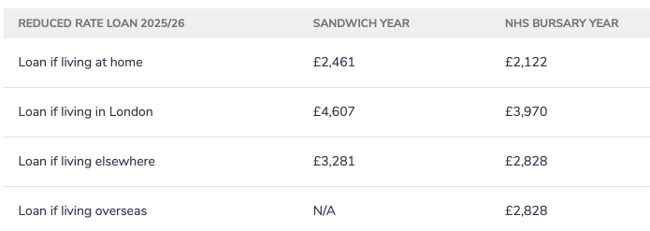
If you’re on a paid placement year or a year when you get an NHS bursary (medical or dental students), you will only get a ‘reduced rate’ maintenance loan. The amount depends on where you live while you study, not on your income.
What are the pros and cons of taking out a student loan?
| Pros | Cons |
|---|---|
| Covers tuition fees for four years | The means-tested element can be punitive |
| Helps widen participation in higher education | The current maintenance loan does not cover cost of living |
| Debt does not impact our credit score (used for loan, mortgage and credit card applications) | There is an expectation for students to have parental contributions or top-up their income with work |
| If you don’t earn above the repayment threshold, you don’t make repayments | The debt graduates leave with can cause psychological distress |
| The debt is wiped after 30yrs/40yrs/death | The interest rate means the debt accumulates faster than it can be paid off |
| The debt is not passed on after your death | Doctors will likely be paying the 9% repayment throughout their careers |
| The 9% repayment is calculated on pre=tax income but paid out of post-deduction income, so is not tax-efficient | |
| Doctors will repay significantly more than they borrowed |
How do you apply for a student loan?
The best way to apply is online, however, there is an option to apply by post. It is recommended to apply as early as possible when the application window opens to allow for time to process the application. You can still apply for funding up to 9 months after the first day of the academic year for your course.
You will need to submit your household income and the details for your parent(s) or partner, depending on your personal circumstances, for them to submit further evidence. You will also be required to submit ID documentation at this stage.
Continuing students will receive a reminder to apply for the next year using their online student finance account.
How do you receive your student loan payments and what should you do with them?
Student loan payments are split into roughly 3 equal payments (once per term) and paid directly into your nominated bank account. You can amend your bank account details anytime on your online Student Finance account.
We recommend having a separate day-to-day current account into which you pay yourself a monthly “salary” based on your budget. There is a trend amongst students to “blow the student loan” when it is paid and having a separate account will help minimise the temptation to spend it all at once. That loan payment needs to cover a whole term.
What are the different undergraduate student loan plans?
Plan 1:
You started university between 1998 – 2011 in England, Scotland, Northern Ireland or Wales (wiped after 30 years from the April after you leave university) or you’re studying in Northern Ireland after 2012 (wiped 25 years from the April after you leave university)
9% of everything they earn over £26,900 a year (or over £2,241 per month)
Plan 2:
You started university between 2012 – 2023 in England or you started university after 2012 in Wales (wiped 30 years from the first April after you leave university)
Graduates repay 9% of everything they earn over £29,385 (£2,448 a month).
Plan 4:
You’re a Scottish student studying anywhere in the UK from September 1998. Loan is wiped 30 years from the first April after you leave university or if you have medical proof of disability that permanently prevents you from working, and are in receipt of a disability-related benefit.
Graduates pay 9% of earnings above £33,795pa.
Plan 5:
You’re starting university from 2023 in England (wipes 40 years from the April you were first due to repay)
Graduates repay 9% of everything they earn over £25,000pa. The £25,000 (£2,083 a month) threshold is frozen until 2027, when it is ‘planned’ to increase with inflation.
How do you repay your student loan?
- Most doctors will repay their student loan via Pay As You Earn (PAYE) which is automatically done by their employer’s payroll. You do not need to do anything.
- Any income from self-employment needs to be declared on a self-assessment tax return for the HMRC to bill you for the correct income tax and student loan repayment.
- Your “income” for student loan purposes isn’t just your salary, it’s also any non-ISA interest, non-ISA dividends, self-employment/side hustle income and certain state benefits.
- You still need to continue repaying your student loan, even if you move abroad
Should you try to overpay your student loan payments or pay it off early?
- Interest will accumulate faster than you can repay with modest overpayments (up to a point)
- It is important to crunch the numbers and see if the growth of the debt will outstrip the overpayments you can make as the money could be put to better use elsewhere
Helpful information for pre-medical students and their parents/guardians
- There is an implicit expectation that parent(s) will make up the shortfall in living costs that the awarded maintenance loan does not meet. Therefore, it is important to plan for this.
- Parents may consider taking a bank loan or remortgaging to pay for university studies. We recommend researching this option thoroughly and taking into account the positive aspects of a student loan (does not affect credit score, no repayment if earning below threshold, wiped after 40yrs/death) when making a decision.
- The penultimate and final year of medical school are covered by the NHS Bursary, which is not anywhere near as much as the maintenance loan from Student Finance. We recommend planning for this added shortfall with your child.
Helpful information for undergraduate (pre-)medical students
- Student loans will cover tuition fees and maintenance costs as a loan for the first 3 (without intercalation) or 4 (with intercalation) of your degree.
- The NHS Bursary will cover the penultimate and final years of your degree.
- There is a significant drop in how much you will receive from your NHS Bursary so prepare for this early by saving any parental contributions or parts of your student loan from your first year (see worked example).
Helpful information for graduate-entry (pre-)medical students:
- If you accessed student finance for your first degree then you will only be eligible for student finance to study medicine if you study on a 4-year graduate-entry medicine course.
- If you want to study medicine as a second undergraduate degree then you will have to fund this yourself.
- You will not start paying your first undergraduate student loan back until you start earning the threshold amount, which is unlikely to be during a full-time GEM course. Therefore, you will start paying both back when you start Foundation Training.
- If you were on Plan 1 for your first degree and then Plan 2 for your GEM degree, then you will start paying both back side-by-side due to the different thresholds. This means your student loan repayments will be higher than someone who either did Medicine as a first degree or someone who was on Plan 2 for both.
- This will also be the case if you did your first degree on a Plan 2 loan and will be starting your GEM degree on Plan 5.
Helpful information for recently graduated doctors
- Student finance loans do not impact your credit score so will not affect your suitability for gaining credit elsewhere.
- Mortgage lenders will include your student loan repayments in their “Affordability Assessments”.
- You need to continue paying your student loan back even if you move abroad.
- Your debt is wiped at the end of the 30 (Plans 1,2 and 4) and 40 (Plan 5) years after the first April following your graduation.
- The debt does not pass to your next of kin and is wiped in the event of your death.
- The 9% repayment is calculated on any earnings above the relevant plan’s threshold before any tax or deductions (gross) but is paid out of net (after tax and deductions) earnings, therefore, it is not income tax efficient.
References
- https://www.gov.uk/student-finance-on-or-after-1-january-2027
- https://www.thecompleteuniversityguide.co.uk/student-advice/finance/university-tuition-fees-and-financial-support-in-england#Maintenance-loans-for-students-from-England
- https://www.gov.uk/government/publications/student-loans-a-guide-to-terms-and-conditions/student-loans-a-guide-to-terms-and-conditions-2026-to-2027
- https://www.thecompleteuniversityguide.co.uk/student-advice/finance/nhs-bursary#ScottishGraduateEntryMedicineScotGEMfunding
- https://www.ucas.com/money-and-student-life/money/student-finance/undergraduate-tuition-fees-and-student-loans
- https://www.ucas.com/finance/student-finance-england/finance-independent-students
- https://www.theuniguide.co.uk/advice/student-finance/how-student-finance-actually-works
- https://www.gov.uk/browse/education/student-finance
- https://www.moneysavingexpert.com/students/university-living-costs-calculator/
- https://www.savethestudent.org/student-finance/maintenance-loans.html
- https://www.gov.uk/apply-for-student-finance/when