


The rates at which we pay income tax in the UK are well known (20%, 40% and 45% in England, Wales and Northern Ireland and 19%, 20%, 21%, 42%, 45% and 48% in Scotland). However, your marginal rate is the rate of tax you pay on an extra £1 of income and this might actually be higher than the tax rates just listed.
At various levels of income, earning that extra £1 may have consequences. In this article Ed (a salaried GP but also an accountant and tax adviser) goes through these and how healthcare professionals can find themselves in the marginal rate tax trap where that extra £1 of income has additional, surprising, tax consequences.
Adjusted net income
Before we go through the tax traps we should mention “adjusted net income” because this matters for most of the tax traps below.
When calculating adjusted net income, your net income includes your all your taxable income including employment earnings, profits from self-employment, rental income, bank interest and dividends (even if the latter two are not high enough to be taxed because of the Personal Savings Allowance or Dividends Allowance they are still included as taxable income) after certain deductions such as your allowance employment expenses and NHS pension. You then “adjust” this amount by taking off any grossed-up donations to charities on which you claim Gift Aid and any private pension contributions you make
This then makes up your adjusted net income.
The High-Income Child Benefit Charge: level of income: £60,000
Those with children can claim for child benefit which is a weekly, tax-free amount that anyone can claim no matter how much they earn. Currently in 2025/26 the relevant amounts are £26.05 a week for the eldest child and £17.25 a week for each of the other children.
To claw this back from higher earners there is the “High-Income Child Benefit Charge” (HICBC) where the government claws back 1% of the child benefit for every £200 of adjusted net income in excess of £60,000. By the time the adjusted net income reaches £80,000 all the child benefit that has been claimed will need to be repaid. If either partner has an adjusted net income of over £60,000 the HICBC applies which leads to a situation where two individuals with adjusted net income each of £59,999 (total combined income £119,998) will not be caught by the HICBC whereas if one partner has £80,000 and the other partner £0 (total combined income £80,000) they will have to repay all claimed child benefit. The government are allegedly working on correcting this unfairness.
If one partner does have an adjusted net income exceeding £60,000 and needs to repay child benefit they will need to file a Self-Assessment Tax Return to make the repayment. Taxpayers are allowed to elect not to receive the benefit which will then prevent anyone with income in excess of £60,000 from claiming child benefit only to then have to repay it back.
Loss of the Tax-Free Personal Allowance of £12,570: level of income £100,000
For those with an adjusted net income (more on this below) over £100,000 the personal allowance begins to be reduced by £1 for every £2 over £100,000 the taxpayer is. By £125,140 of adjusted net income the personal allowance is completely removed. This creates a marginal rate between £100,000 and £125,140 of 60% (but higher if you include National Insurance, pension contributions and student loan contributions!). Note this is 67.5% in Scotland so even higher.
Loss of the Tax-Free Childcare of £12,570: level of income £100,000
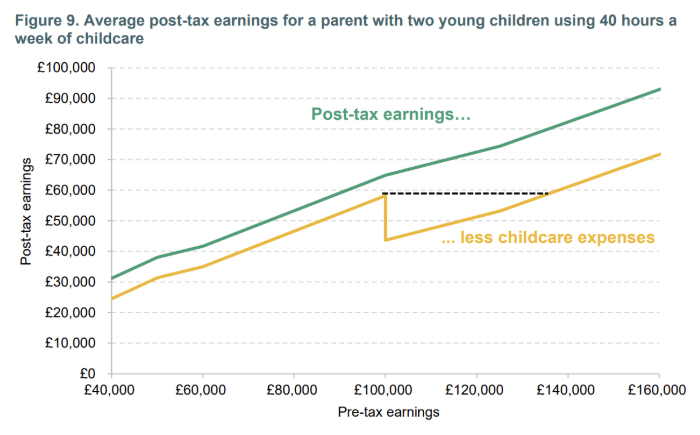
For those with children, there is more bad news when the level of income of either partner exceeds £100,000 because even £1 over this will lead to a complete loss of any entitlement to the Tax-free Childcare Scheme. This is a government scheme where you get up to £500 every three months, up to £2,000 a year, for each of your children to help with the costs of childcare (more if your child is disabled). Just £1 over £100,000 of adjusted net income can then have a significant impact if this help towards childcare costs is entirely lost. You also will lose access to free childcare places which again can have a sizeable impact!
The Institute of Fiscal Studies have done analysis of the effects of this tax-trap and, as you can see from this graph below, a parent with two young children using 40 hours of childcare is better off earning £99,999 than £140,000.
https://ifs.org.uk/sites/default/files/2023-09/IFS-R274-Early-years-spending-update-Budget-reforms-and-beyond.pdf
Tapering of the Pension’s Annual Allowance of £60,000: level of income £200,000
The pension’s Annual Allowance tax remains an issue for higher earning doctors; of particular note, if your taxable income exceeds £200,000 then the annual allowance you have available to offset against your annual pension growth changes can begin to taper away.
For the 2025/26 tax year, this applies if your “adjusted income” is over £260,000 and your “threshold income” is over £200,000. The annual allowance is reduced by £1 for every £2 your adjusted income exceeds £260,000, down to a minimum of £10,000
Note there are two levels of income that are relevant here:
- Your “threshold income” which is all your income minus the amount you pay into a pension. It is worth noting a few things:
- If employed your P60 taxable income will have already had the pension deducted so don’t deduct it again
- unlike adjusted net income above you do not take gift aid into account
- Any bank interest and dividends should be included on the basis of the amount received. You shouldn’t deduct either the savings or dividend allowance
- Remember to deduct any subscriptions or other allowable expenses included on your tax return.
- Your “adjusted income” which is all your income plus the amount your employer pays into your pension, or in the case of the NHS pension the value of the pension growth.
This can lead to some levels of income where the additional tax generated exceeds the income you earn.
Other
There are other areas of taxation where income thresholds cause problems including:
- Corporation Tax: The rates of corporation tax on company profits are 19% for profits under £50,000 and 25% for profits over £250,000. For any profits in between tax is paid at 25% but with something called “marginal relief” applied to reduce the tax burden from the full 25%. However, perversely, this marginal relief leads to a marginal rate of 26.5% for every new £1 of profit between £50,000 and £250,000.
- VAT: perhaps not so much a marginal rate but currently if a business has a turnover on VAT-able supplies that exceeds £90,000 VAT will need to be applied (usually at 20%). The business will then not only have to increase its prices by 20% but will also have an increased admin burden. This deters businesses from expanding beyond a £90,000 turnover.
Conclusion
It is very important that doctors and other healthcare professionals are aware that an extra £1 of income may have additional tax consequences. In particular, for those with children, going over £100,000 (which of course ordinarily is a very nice) can cause serious financial problems if the money from the tax-free childcare scheme is lost.
Want to know what to do about the marginal tax trap? Check out this article next:
https://medicsmoney.co.uk/ep-254-the-60-marginal-rate-tax-trap-and-how-to-avoid-it/


